A day of connection for Ngā Ngaru Wakapuke's early career researchers
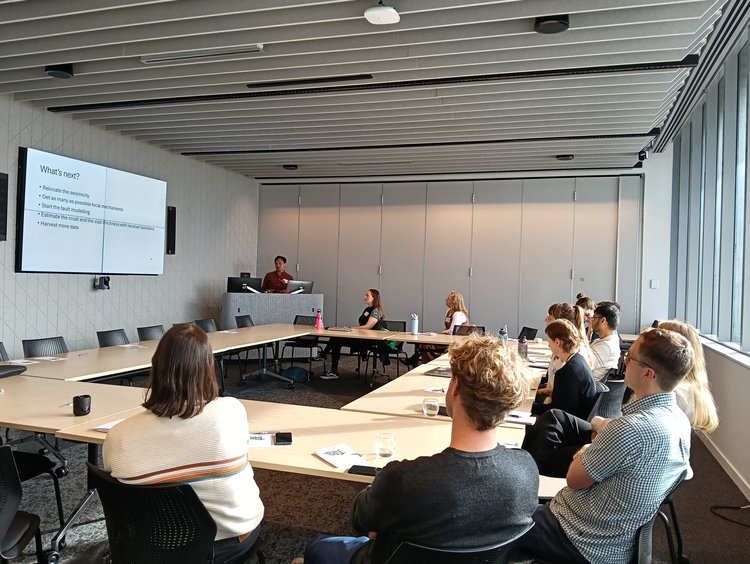
On 9 June 2026, thirteen early career researchers gathered at Victoria University of Wellington's Pipitea Campus for the Ngā Ngaru Wakapuke (NNW) ECR Wānanga. As PhD students, postdoctoral research fellows and designers from five institutions (Massey University, University of Canterbury, Victoria University of Wellington, the University of Otago, and Earth Sciences New Zealand), we spent a full day getting to know each other and discussing our research.
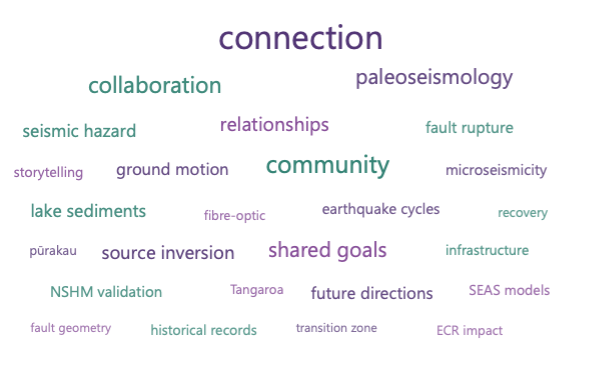
Programme co-leads Jamie Howarth and Caroline Orchiston opened the day with an overview of NNW’s overarching goals and progress to date, joined by Kim King (NNW programme manager) and Kelvin Tapuke (RA1 co-lead). Two postdoctoral research fellows then delivered talks on new methods being developed to constrain the rupture behaviour of historical earthquakes across the transition zone, and on the clustering of large earthquakes in the lower North Island. A second session then brought together PhD students and designers from across all four research aims, ranging from Tangaroa voyage storytelling and pūrakau around earthquakes, to paleoseismology on the Marlborough Fault System and microseismicity across the plate boundary. The afternoon poster session saw presentations from three PhD students and three postdoctoral research fellows across RA2 and RA3 on the testing of the National Seismic Hazard Model using paleoseismic records, the role of fault geometry in synthetic earthquake catalogues, and modelling infrastructure vulnerability and long-term recovery from multiple earthquakes. Together, the oral and poster presentations throughout the day reflected NNW's interdisciplinary mix of geological, geophysical, engineering, and social science approaches.
An afternoon breakout session then gave us space to reflect on where we stand as a cohort. We first mapped the cross-research-aim connections between our work, making visible where our contributions sit within the programme and where the gaps remain. We then turned to where we're heading, grouping ourselves by where our research sits in the NNW pipeline, from foundational, upstream science, to physical damage and impact, through to translating the science into output scenarios and storylines. The exercise helped us see where each of us sits within the wider programme, and where the natural connections lie across the research aims.
Across the science and discussion sessions, a few things stood out. Above all, the group valued in-person connection, and we look forward to building on it at the upcoming QuakeCoRE and GSNZ annual meetings. They also noted that the ECR-only format gave everyone the confidence to speak openly about their work. The day closed with a karakia, before heading out for an evening of bowling and dinner together, a fun way to cement the connections made over the day.